The purpose and difference between explosion-proof electric valves and solenoid valves
4991 Views
2018-08-11
An electromagnetic valve is an electromagnetic coil that generates magnetic attraction after being energized, overcomes the pressure of the spring, and drives the valve core to move. It is an electromagnetic coil with a simple structure and low price, and can only achieve switching;
Electric valves drive the valve stem through an electric motor, which drives the valve core to move. Electric valves are further divided into shut-off valves and regulating valves. The shut-off valve is a two position operation, namely fully open and fully closed. The regulating valve is equipped with an electric valve positioner on top, which dynamically stabilizes the valve in one position through closed-loop adjustment.
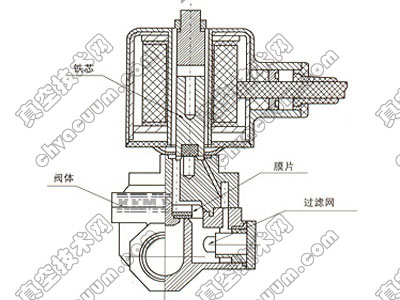
Schematic diagram of electromagnetic valve structure
Purpose of electric and solenoid valves:
Electromagnetic valve: used for on-off control of liquid and gas pipelines, it is a two position DO control. Generally used for control of small pipelines.
Electric valve: used for analog quantity regulation of medium flow in pipelines of liquid, gas, and air systems, and is controlled by AI. In the control of large valves and air systems, electric valves can also be used as two position switch controls.
Electromagnetic valve: It can only be used as a switching value, for DO control, and can only be used for small pipeline control. It is common in DN50 and below pipelines, and is rarely used upwards.
Electric valve: It can have AI feedback signal and can be controlled by DO or AO, which is more common in large pipelines and air valves.
1. Switch form: The solenoid valve is driven by a coil and can only be turned on or off, with a short action time during switching. The drive of an electric valve is usually achieved by a motor, which takes a certain amount of time to simulate the opening or closing action and can be adjusted.
2. Job nature: Electromagnetic valves generally have a small flow coefficient and a small working pressure difference. For example, the flow coefficient of a 25 caliber solenoid valve is much smaller than that of a 15 caliber electric ball valve. The drive of the solenoid valve is through an electromagnetic coil, which is relatively easy to be damaged by voltage shocks. Equivalent to the function of a switch, it has two functions: on and off.
The driving of electric valves is usually done by a motor, which is relatively resistant to voltage shocks. Electromagnetic valves are quick opening and quick closing, generally used in places with low flow and pressure, and require high switching frequency. Electric valves are the opposite. The opening of the electric valve can be controlled, with states of open, closed, half open, and half closed. It can control the flow of medium in the pipeline, but the electromagnetic valve cannot meet this requirement.
Electromagnetic valves can generally be reset when powered off, while electric valves require a reset device for such functions.
3. Applicable process: Electromagnetic valves are suitable for special process requirements, such as leakage and special fluid media, and are relatively expensive. Electric valves are generally used for regulation, and there are also switch values, such as the end of fan coil units.